KoreLab is the cloud software for food safety and quality consultants: from HACCP to the voluntary standards — IFS Food, BRCGS, ISO 9001/22000 and FSSC — manage all your clients from a single dashboard. For a new client you prepare the entire first draft of the dossier under delegation, for later revisions you propose signed changes — no scattered files, no diverging versions, no re-entering anything.
€39/month (€390/year), VAT excluded · Early Adopter promo -25% until 31 October 2026 · Quality & Certifications side, multi-client.
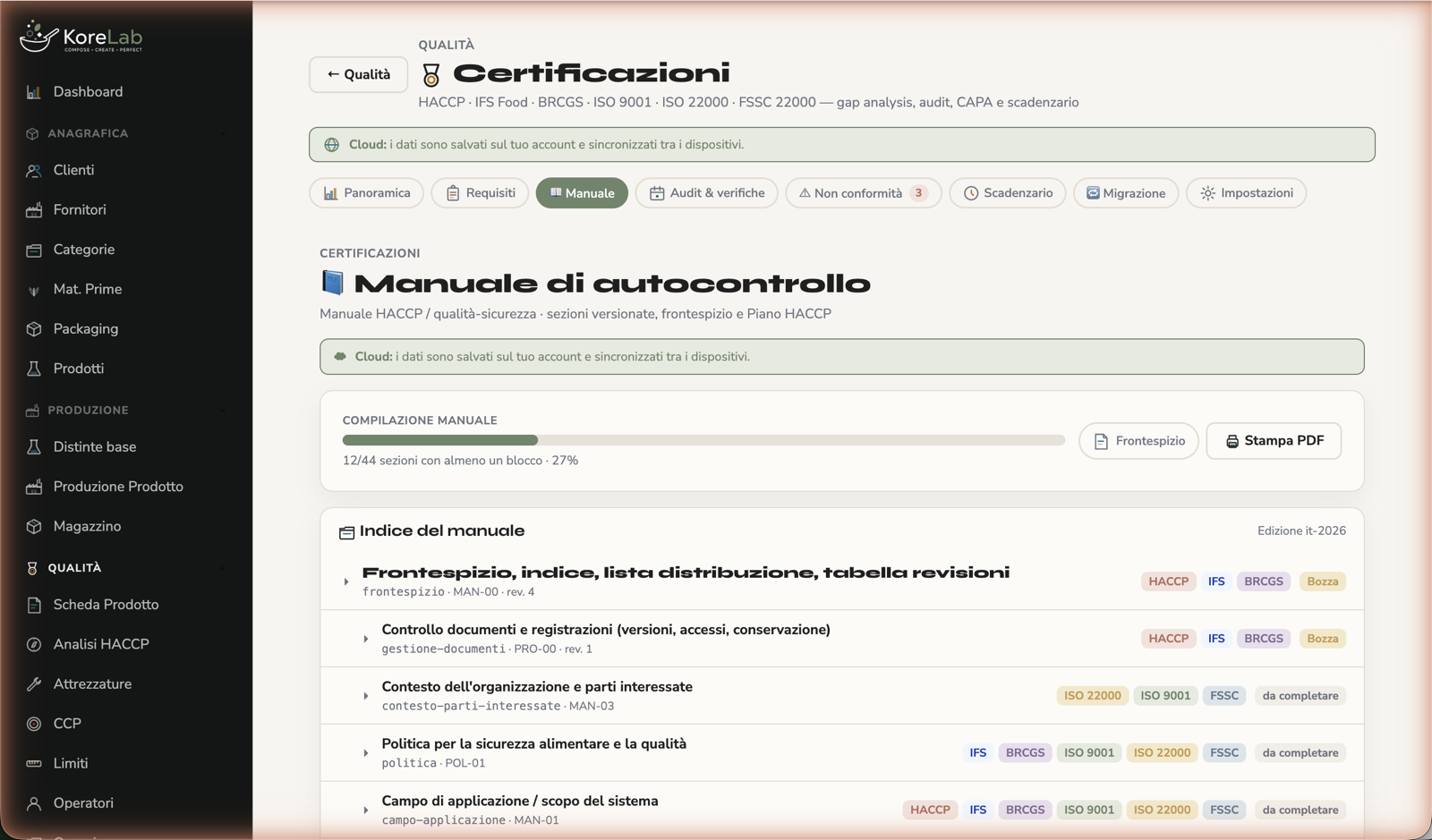
For each client you work on the self-monitoring manual with tracked versions (draft, approved, obsolete): you propose the changes, the company confirms and signs (dual signature), and everything stays sealed in the dossier. No more copy-paste between diverging Word files.
The more businesses you follow, the more fragmented the work becomes. Each client is a different folder, each manual is a copy-and-paste, and when the certification body arrives nobody knows which version is the right one.
Excel on your PC, PDFs in emails, paper records in the client's back room, a USB stick passed between sites. When you need a piece of data, the treasure hunt begins.
You have one draft, the client has edited another, the audit sees a third. Nobody knows which one is approved and when what changed.
For every new client you rewrite sections you have already written a hundred times. Time burned on repetitive work instead of risk analysis.
A record corrected in pen, a temperature crossed out and rewritten: there is no way to prove who did what and when. At verification time, that's a problem.
Did you edit the manual or did the client? Who takes responsibility in front of the auditor? Without a trail, the line gets blurry.
Trips to retrieve a record, manual data re-entry, emails asking "which is the latest version?". Hours you can't bill.
KoreLab does not belong to any consulting firm. It is an independent tool: you adopt it as your own method, you bring it to every client, and no competitor looks inside your portfolio. The data stays with the client, the method stays yours.
All the work on the Quality & Certifications side, for every client, from a single interface. One single source of truth: the client's data, never copies to keep aligned.
All your clients in one dashboard. Switch client with one click and land in their dossier: manual, hazards, records, deadlines. No multiple logins, no separate folders.
The client grants you delegation and you see their real data in real time, read-only. There is a single source — the client's data, with one single integrity chain (hash-chain). No copies to synchronise, no misalignment.
You generate a link to a "frozen" read-only dossier, with an expiry date. You share it for example with the certification body or with a reviewer: they see the snapshot of the dossier as of that date, without accessing the live system.
On the Manual and on the client's data you don't write behind their back: you propose a change, signing it with your PIN. The client sees it, evaluates it, confirms it and signs it. Two signatures, clear responsibility. The «propose → confirm» model is no longer just for the Manual: it also extends to the Management review, Complaints, Training sessions and internal-audit planning.
Versioned self-monitoring manual, hazard analysis by step, CCPs and critical limits, monitoring plan, operational records, warehouse & traceability, mock recall, supplier/FCM evaluations, Food Defence (TACCP), Food Fraud (VACCP), gap analysis, documents & attachments, training, complaints, management review and internal audits. All in one place.
HACCP (base always active), IFS Food v8, BRCGS Issue 9, ISO 9001:2015, ISO 22000:2018, FSSC 22000 v7. Cross-mapping of clauses unifies equivalent requirements: you demonstrate the same requirement only once across multiple standards.
Build your library of templates (manual texts, critical limits, settings) and reuse it across all clients. Export it and import it between accounts. Write once, apply everywhere.
You and the client exchange notifications both ways. The proposal queue shows a badge with how many are awaiting confirmation: no request is lost, no signature is left pending.
Goods receipt with batch/delivery note/expiry, FEFO stock from an append-only ledger, one-step-back / one-step-forward traceability (art. 18 Reg. (EC) 178/2002) and recall tests with the list of clients to alert. Ready to show in an audit.
The "propose → confirm" flow in 5 steps. You work, the client validates, the change enters the dossier sealed. It applies to the Manual and to quality operations: management review, complaints, training and internal audits.
The client invites you or grants you delegated access. From that moment you see their real data, read-only. The delegation is theirs and they can revoke it whenever they want.
No local copies: you analyse the manual, the hazards by step, the CCPs, the records and traceability directly on the client's single source. What you see is the truth of the dossier.
When you want to change a section of the Manual or a piece of data, you create a proposal and sign it with your PIN. The proposal stays tracked: who made it, when, what changes.
The client — the FBO, typically the Self-monitoring Manager or QA Manager — receives the proposal, evaluates it, confirms it and signs it with THEIR PIN. That's the dual signature: you propose, they validate and take responsibility.
On confirmation the change enters the dossier hooked to the hash-chain (concatenated SHA-256 seal), idempotently and transactionally. The "Verify integrity" function recalculates the chain: "✓ chain intact".
The "propose → confirm" flow is designed for one-off revisions on a dossier already up and running. For a client starting from scratch, KoreLab gives you a dedicated mode: you prepare the entire first draft yourself, the client adopts it and takes on the responsibility.
With a dedicated switch — revocable at any time — the client authorises you to write in draft directly in their dossier, not just to propose.
Requirements and gap analysis, hazard analysis by step, CCPs and critical limits, record templates, equipment, org chart: you prepare the entire documentation framework, not just the Manual.
Until it is adopted, every page of the client's dossier carries a fixed warning: it is not yet a valid dossier. Every PDF exported at this stage is marked "DRAFT — not adopted", with no evidentiary value.
Once the work is done, you deliver. The company — the FBO, typically the Self-monitoring Manager or QA Manager — reviews what you prepared and adopts it by signing with their own PIN.
Upon adoption the dossier enters the hash-chain and freezes: from that moment food safety responsibility belongs to the company, no longer to you.
Warehouse traceability remains the client's own operations (you see it only if they allow it); their documents and attachments stay read-only even in this mode.
Beyond the dossier, you also prepare the people: you generate a multiple-choice test on good HACCP practices and send it to the client's operators, with no need for them to open a KoreLab account.
Each operator receives a personal link and takes the test from a dedicated portal: they declare their identity and a statement of responsibility, then immediately see their score, weak topics and question-by-question correction.
Correct answers are never readable from the operator's device. Every link is personal and expiring, with questions and option order frozen at the moment it's sent.
HACCP principles and critical points, personal hygiene, temperature and cold chain, cleaning and sanitisation, traceability/labelling/recall — each with a regulatory citation, written offline (never AI-generated at runtime) and verified through an independent double review.
Illustrated study material on the 5 topics to send before the test as preparation, and a downloadable certificate for those who pass — both with KoreLab's visual identity.
Before receiving the study guide or test, every operator gives consent to the processing of their data from a dedicated page; consent and any revocation stay permanently tracked. The client company remains the data controller, you act under delegation.
When an operator completes the test, you confirm it by signing with your PIN: it becomes a Training-session proposal (the same "propose → confirm" model), which the FBO approves and records, feeding the skills matrix and the 24-month renewal deadline.
The concrete benefits for those who provide HACCP consultancy across multiple businesses: less wasted time, more control, clear responsibility.
Templates reusable across clients, one dashboard for all, zero data re-entry. You reduce repetitive work and dedicate the hours to risk analysis — what the client really pays for.
Versioned manual, append-only ALCOA+ records, traceability and gap analysis always up to date and verifiable. When the certification body arrives, the dossier is already ready and demonstrable.
You propose, the FBO validates and takes responsibility with their signature. The boundary between consultant and operator is sharp, exactly as it should be in front of an auditor.
For every change it stays recorded who proposed, who approved and who signed, with date and time. No more "who touched what?": the answer is in the dossier.
One single source of truth per client. Diverging versions, USB sticks and emails with duplicate attachments disappear. What's in the dossier is the real version.
No trips just to retrieve a record. You access the client's real data from wherever you are and act in real time, on the single source, not on an old copy.
Tidy snapshots, clean dossiers, signed and tracked proposals. You present yourself to the client and the certification body with a solid, verifiable method, not with improvised folders.
The same workflow on every business you follow. You grow in client numbers without multiplying the chaos: the method stays a single one.
The Consultant plan is designed for those who do self-monitoring and quality as a profession, across multiple artisan food businesses.
You follow multiple workshops, charcuterie makers, dairies, pasta makers, breweries. You want one single method, audit-ready dossiers and less time on repetitive work. KoreLab gives you everything in one dashboard.
Multiple consultants, a shared client base. Common template library, uniform proposal-signature flow and traceability of who did what on each client.
Groups with multiple plants or production retail outlets. Keep the dossiers of the various sites aligned with the same documentation framework and the same standards.
The full Quality & Certifications suite, across multiple clients, with live synchronisation and signed proposals. Prices VAT excluded.
Quality & Certifications side MULTI-CLIENT: single dashboard, live delegated access, read-only snapshot, signed change proposals, reusable template library, sync with the client, certifications suite included. The right choice if you follow multiple businesses.
Adds to Free or Starter and enables the Quality suite on a single business. It's designed for the individual producer, not for those managing a portfolio of clients. Included in Pro, Qualità and Consultant.
Only the Quality & Certifications side (no commercial side or AI) for a single business, certification included. Great for the business that does it itself, but it stays single-client: it's not multi-client like the Consultant plan.
We tell it like it is: it's important you know exactly what KoreLab does and does not do.
KoreLab does not certify. It is a management and self-monitoring tool: it prepares and guides towards certification and keeps the dossier ready for the audit and for the certification body. It does not issue certifications and is not "Accredia-accredited".
The signature is a simple electronic signature — server-side verified PIN + chain seal with concatenated SHA-256 hash. It is not a qualified electronic signature (QES) and it is not a legal timestamp. We provide solidity and internal traceability, not the value of a qualified signature.
You propose, the FBO stays responsible. The consultant proposes with their own PIN; the client's FBO (Self-monitoring Manager / QA Manager) approves, signs with their own PIN and retains responsibility for the dossier. The dual signature makes this boundary explicit.
In delegated preparation, responsibility transfers to the company only on adoption. Until the client adopts and signs with their own PIN, what you write is a draft with no evidentiary value (every exported PDF states this): food safety responsibility remains, as always, the FBO's — and it formally transfers to them only with the signed adoption.
The data stays the client's. Delegated access is a grant from the client, revocable at any time. The source stays single (the client's data, one single hash-chain) and processing takes place in compliance with the GDPR.
The HACCP test stays under the company's control. Operators give their GDPR consent before receiving the study guide or test; the data controller remains the client company (FBO), you act under delegation. The result enters the client's dossier only after your PIN confirmation and the FBO's approval — never automatically.
The regulatory texts are indicative, to be verified and adapted. KoreLab does not provide legal advice and does not reproduce the full text of the standards.
The answers to the most common questions of those who provide HACCP consultancy across multiple clients.
Activate the Consultant plan, get your clients' delegation and keep every dossier audit-ready — with signed proposals, traceability and reusable templates. Early Adopter promo -25% until 31 October 2026.