Sooner or later, if you work with large retail chains or foreign customers, the question arrives: "do you have an IFS or BRC certification?". The confusion between IFS, BRCGS, ISO 22000 and FSSC 22000 is very common, because all four concern food safety but arise from different needs. Let's see what really sets one apart from another.
The common starting point: HACCP
All four standards are built on HACCP: ISO 22000 integrates it into its own management system, while IFS, BRCGS and FSSC 22000 require it as a foundation. None of them replaces the HACCP self-control (autocontrollo) required by law (here are the 7 HACCP principles): they extend it with additional requirements on document management, traceability, supplier management, infrastructure and company quality culture.
A useful clarification: IFS, BRCGS, ISO 22000 and FSSC 22000 are schemes, that is, sets of requirements. The certification is not issued by whoever wrote the scheme but by an accredited certification body, which checks your company through an audit.
ISO 22000
This is the general-purpose international standard for food safety management systems, published by ISO. It is less prescriptive on plant and packaging details (it still asks for prerequisite programmes, but leaves more freedom on how to meet them) and more focused on the management system itself, along the lines of other ISO standards. It is often the most natural starting point for those already familiar with quality management systems. Note: ISO 22000 on its own is not among the schemes recognised by the GFSI; if a customer asks for GFSI recognition you need a recognised scheme, for example FSSC 22000.
FSSC 22000
It was created as an "extension" of ISO 22000: it takes the ISO standard as its base and adds sector-specific prerequisite programmes (the ISO 22002 series) and additional scheme requirements, closer to what the GFSI and large retail ask for. It is recognised by the GFSI (Global Food Safety Initiative), which makes it accepted by many international retailers as an alternative to IFS or BRCGS.
BRCGS (formerly BRC)
A standard born in the United Kingdom, widely used among suppliers to British large retail and beyond. It is more prescriptive than ISO 22000: it sets detailed requirements on infrastructure, plant layout, foreign-body management and food safety culture. It is often explicitly required by UK and Northern European retailers.
IFS (International Featured Standards)
It was created in 2003 by a joint initiative of the German (HDE) and French (FCD) retail federations; in the following years the federations of other countries, including Italy, joined too. It is widespread in the large retail of Italy, France and Germany and is similar to BRCGS in its level of detail. IFS Food is also recognised by the GFSI; version 8 has been since September 2024.
| Standard | Origin | GFSI recognised |
|---|---|---|
| ISO 22000 | International ISO standard on food safety management systems | Not on its own |
| FSSC 22000 | ISO 22000 with sector prerequisites and additional scheme requirements | Yes |
| BRCGS | United Kingdom, created for large-retail suppliers | Yes |
| IFS | German and French retail federations (2003) | Yes (IFS Food v8 since September 2024) |
For the up-to-date list of recognised schemes and versions, the GFSI website is the reference; standard versions change over time, so always check the one your customer requires.
Which to choose: the right question is not "the best one"
There is no standard that is objectively "harder" or "more complete" in the abstract — the choice almost always depends on who is asking you for it:
- If you work (or want to work) with Italian or French large retail, IFS is a very widespread standard among retailers: ask the customer which scheme and which version it requires.
- If your market is the UK or Northern Europe, BRCGS is the most common among retailer requirements.
- If you are looking for a leaner management system, recognised internationally, and no specific retailer imposes a standard on you, ISO 22000 (moving to FSSC 22000 if GFSI recognition is needed) may be the most efficient choice, provided that no customer asks you for a GFSI-recognised scheme.
In practice, the choice almost always starts from a concrete request by a customer or a sales channel, not from an abstract initiative — and that is a good thing, because it avoids getting certified to a standard that nobody will ever really ask you for. For a small workshop it is worth asking the customer first which scheme and which version it requires, and evaluating with the certification body the timing, effort and costs of the path. The schemes provide for an outcome with a level or a score (for example a percentage in IFS, a grade in BRCGS), not a simple yes or no.
How to prepare, whichever standard you choose
The preparation work is largely common to all four standards, because it rests on the same foundations:
- A solid, up-to-date HACCP system, with CCPs, critical limits and records consistent with real production.
- Batch traceability verified with a periodic recall test (mock recall).
- Documented supplier management, with qualification and monitoring over time.
- Technical sheets and allergen declarations consistent across recipe, label and internal documentation.
- A preliminary gap analysis against the specific requirements of the chosen standard, to understand where to concentrate the work before the audit.
How KoreLab helps you prepare
First a clarification: KoreLab does not issue certifications and does not replace the certification body, which remains the only one to decide. What it does is help you build and demonstrate every day the system that the audit will go and check. The multi-standard suite (IFS, BRCGS, ISO 22000, FSSC 22000) is in the Business, Qualità and Consulente plans; HACCP self-control, which is its foundation, is included in the Pro plan or can be activated as an add-on on the Free and Starter plans. Here is how it connects to the five preparation points above.
1. A solid, up-to-date HACCP system
What KoreLab does
The HACCP manual is versioned, the hazard analysis and the critical control points (CCPs) have a code and critical limits, and the records are tracked. If a recorded value is out of limit, by default a Non-Conformity opens on its own (the rule can be changed in the settings).
Why it does it
The verdict has to be calculated from the data, not declared in words: it is what an auditor looks for when checking whether the system really works.
What it solves
The manual does not fall behind production, and the records are dated evidence, not sheets filled in from memory at the end of the week.
2. Batch traceability and mock recall
What KoreLab does
You load goods with the supplier's batch, delivery note (DDT) and expiry date, and you can trace the supply chain upstream and downstream. The recall test (mock recall) returns the list of customers to notify and can be closed in a report signed with the operator's PIN (simple electronic signature) and sealed, kept as dated evidence.
Why it does it
A recall is tested before it is really needed, and for an auditor it is not enough to know that you simulated it: they want to see the proof.
What it solves
You trace the supply chain from the batch, upstream and downstream, without rebuilding it from paper delivery notes, and you have the test documentation at hand for the audit.
3. Documented supplier management
What KoreLab does
You qualify and periodically assess suppliers and food contact materials (MOCA), with criteria and assessments linked to the real records. A single deadline calendar gathers the due dates: obligations, documents, calibrations.
Why it does it
The standards ask for supplier management to be structured and demonstrable over time, not merely declared.
What it solves
Qualification and monitoring are documented without having to piece together spreadsheets and emails before the audit.
4. Consistent technical sheets and allergens
What KoreLab does
The technical sheet is generated from the recipe and the allergens derive from the ingredients, so recipe, sheet and label start from the same data.
Why it does it
Contradictions between documents of the same process are one of the reasons people arrive at the audit out of breath: if the data has a single source, it cannot diverge.
What it solves
You do not risk handing over two documents that say different things about the same product.
5. A preliminary gap analysis
What KoreLab does
For each active standard you get a gap analysis with a dashboard: percentage of requirements met, open non-conformities and upcoming deadlines. If you activate several standards, when you assess an area as met, the equivalent area in the other standards inherits the status «partial, to be reconfirmed» with the same evidence: the confirmation remains yours, and it is never declared as met automatically.
Why it does it
Knowing where to concentrate the work before the audit is more useful than finding out during it, and if one customer asks for IFS and another for BRCGS you do not want to rebuild the same evidence from scratch.
What it solves
You see in real time where you stand and what is missing, instead of rebuilding it at the last minute. For details you can read the page on quality and certifications.
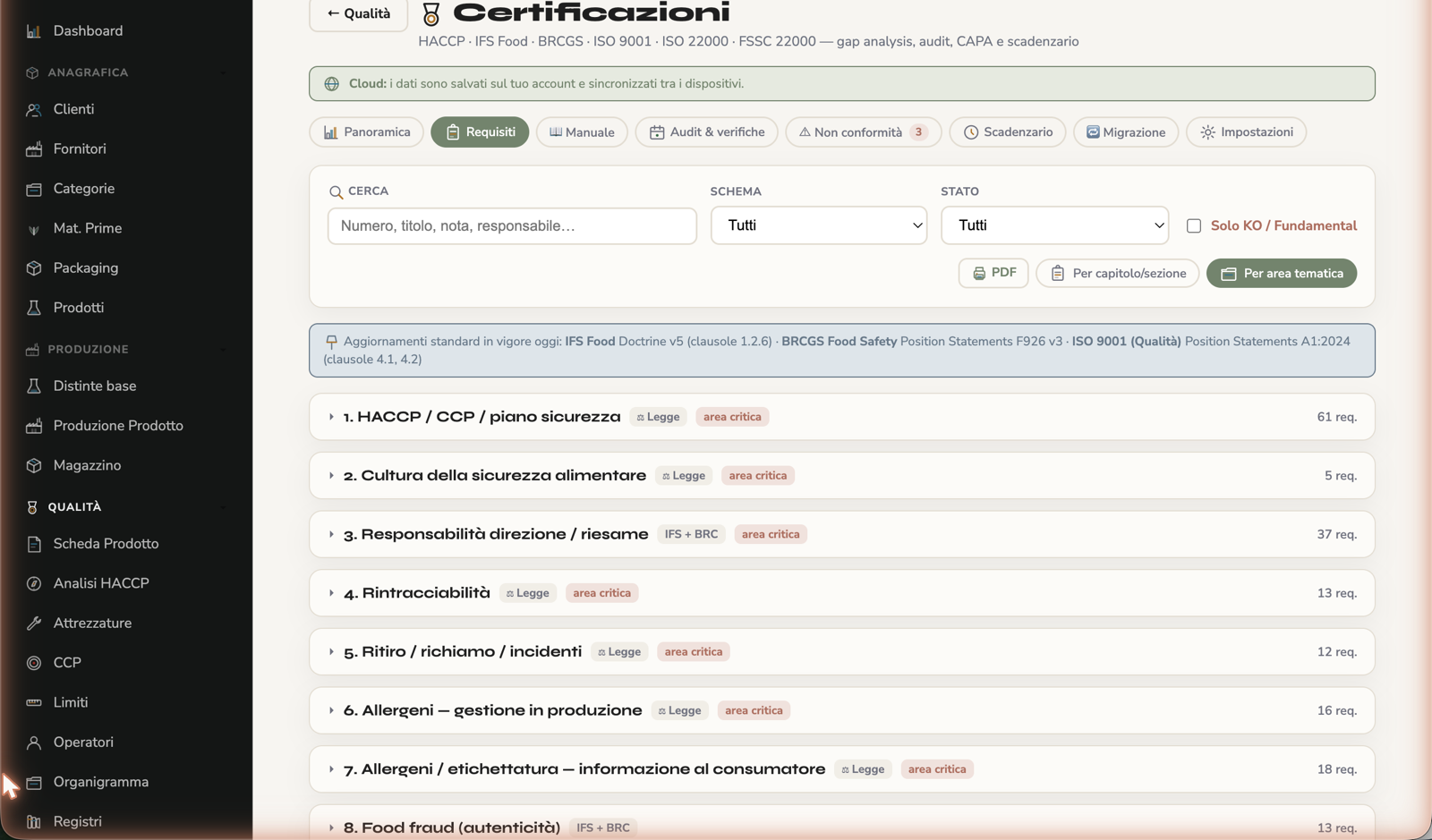
The quality suite is not in the Free plan: on the quality and certifications and Consulente plan pages you will find what each plan includes and how it is activated. If you want to start from recipes and bills of materials, the Free plan is free and requires no credit card: create a free account.
In short
ISO 22000, FSSC 22000, BRCGS and IFS share the same HACCP base, but differ in origin, level of prescription and recognition by the GFSI and by retailers. The right choice is almost always driven by who is asking you for it, not by an abstract judgement on which is "the best" — and preparation, whichever standard you choose, starts from HACCP, traceability and suppliers kept in order all year round, not just before the audit.