You buy flour, butter, sugar, eggs; you weigh the raw dough and you get a number. But that number is almost never the weight of the product that ends up on the shelf or in the display case. Between raw dough and finished product there is cooking, and cooking makes you lose weight — mostly water. That loss is called weight loss, and its counterpart is yield: how much finished product you really get from a given amount of raw materials.
What weight loss is
Weight loss is the difference, as a percentage, between the weight of the raw dough (or product) and its weight after cooking or processing:
Weight loss % = ((raw weight − cooked weight) ÷ raw weight) × 100
If a dough weighs 920 g raw and 800 g after baking, the weight loss is (920−800)/920 × 100 = 13%. That 13% is not wasted raw material: it is water that evaporated during cooking, which is normal for that type of product.
What yield is
Yield is the complement of weight loss: how much finished product you get per unit of raw material or raw dough. In the example above, the yield is 800/920 = 87%. Knowing your real yield — measured, not estimated — is what lets you know how many pieces you actually get from a batch, not how many "should" come out in theory.
Why it matters for cost
The cost of the raw materials does not change with cooking — you bought and paid for them either way. But if you sell by weight or calculate the cost per kilo of finished product, weight loss changes the sum substantially. Let's take the numbers of the tart already seen in the article on how to calculate food cost (€3.23 of ingredients, the same as in the comparison between food cost and CPF), this time to look at what happens to the cost per kilo:
| Weight | Cost per kg | |
|---|---|---|
| Raw dough | 0.920 kg | €3.23 ÷ 0.920 = €3.51/kg |
| Baked product | 0.800 kg | €3.23 ÷ 0.800 = €4.04/kg |
Calculating the cost on the raw weight instead of the cooked weight makes the product look cheaper than it is: the real cost turns out to be about 15% higher than the one calculated on the raw weight (€3.51/kg against €4.04/kg), in other words the calculation on the raw weight understates it by about 13%. On significant volumes, that difference turns into margin lost every day, without anyone noticing — because the sum "seems" to add up.
The effect grows with the loss. A second example, with made-up numbers for illustration: a dough of 1,000 g raw with ingredients costing €4.00 that weighs 750 g after processing has a 25% loss. On the raw weight the cost is €4.00/kg, on the finished product €4.00 ÷ 0.750 = €5.33/kg: about 33% more. In general, the cost per kilo of the finished product is the cost on the raw weight divided by (1 − loss): with a 13% loss it rises by about 15%, with a 25% loss by about 33%.
Not all weight losses are equal
Weight loss varies a lot depending on the product and the process. There is no official table valid for every case — the values you find around are indicative, not regulatory standards — but as a rough guide:
- Leavened baked goods (bread, panettone) tend to have more marked weight loss, often in double-digit percentages, depending on size and baking time.
- Compact pastry products (tarts, biscuits) generally have smaller losses, but not negligible ones.
- Cooked meat and fish can have significant weight loss, often higher than that of baked goods, depending on the cooking technique.
- Cheeses have their own specific yield from milk, conceptually different from cooking weight loss but with the same logic: the cost must refer to the finished product, not to the starting raw material.
That is why yield must always be measured for each specific recipe, not estimated by analogy with a "textbook" value: it can differ considerably from the real yield of your oven, your dough, your technique — and it is the only truly reliable figure for the cost calculation.
How to measure it correctly
- Weigh the dough (or raw material) before processing/cooking, over several batches to get a reliable figure.
- Weigh the finished product right after it has cooled to a standard temperature, so that further evaporation after cooking does not distort the figure.
- Calculate the average yield over at least 3-5 batches, not on a single data point that might be an exception.
- Update the yield in the recipe when you change oven, cooking time or format — yield is not a universal constant of the product, it is tied to your specific process.
The risk of ignoring it
Ignored weight loss is one of the most frequent errors in food cost calculation: it is not a formula error, it is a missing piece of data. The sum "seems" right because the formula is correct — it is just applied to the wrong weight. It is one of those errors that stays invisible until you compare the theoretical numbers with the real ones at the end of the month.
How KoreLab solves these problems
Weight loss is a figure that is easily lost: it sits in a spreadsheet, in a note by the oven, in the head of whoever produces. Here is how KoreLab brings it into the recipe, problem by problem.
1. Cost calculated on the raw weight
What KoreLab does
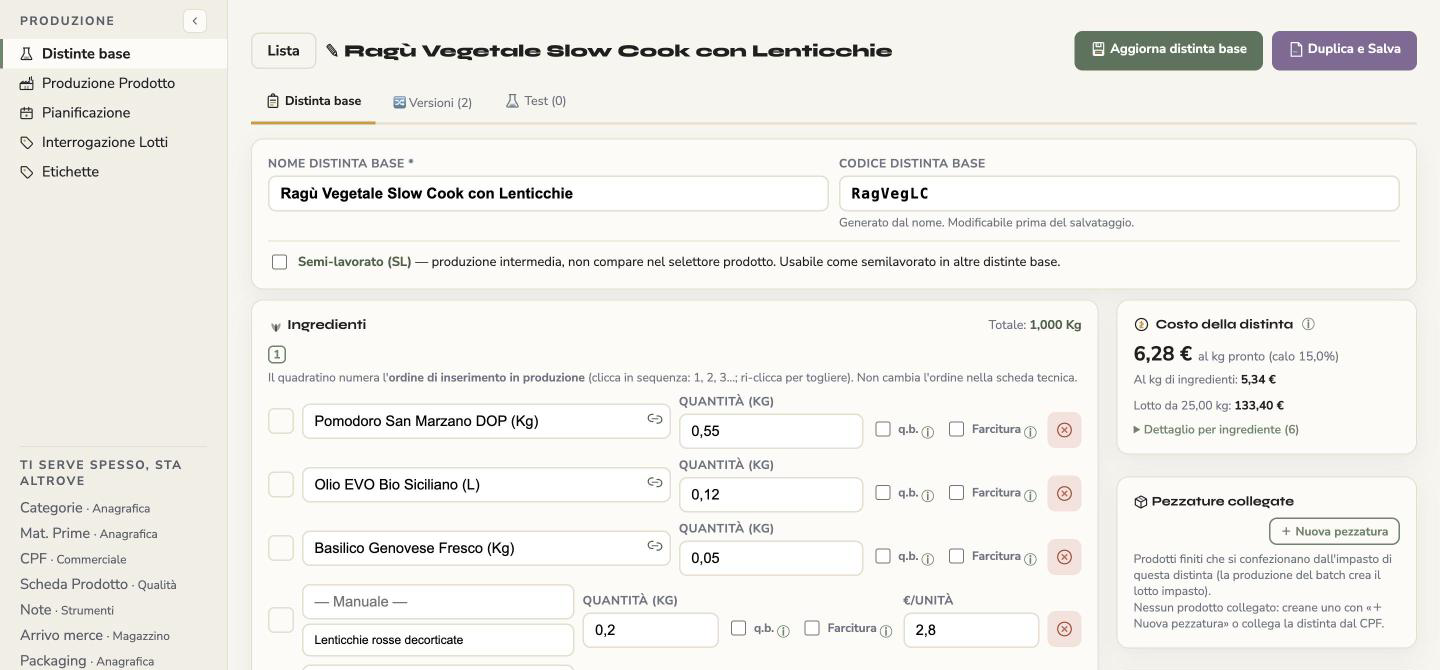
In the recipe (bill of materials) you record ingredients, batch and process weight loss. The "ready" cost per kg (that is, after the loss), the net weight and the CPF (full production cost) per piece are calculated on the finished product, not on the raw dough.
Why it does it
The cost of the raw materials does not change with cooking, but the weight does: if the calculation stays on the raw weight, the cost per kilo or per piece comes out lower than the true one. The loss therefore has to be inside the calculation, not in a separate step you have to remember.
What it solves
The cost you read refers to the finished product, the one you really sell. You reduce the risk of finding out at the end of the month that the real margin was lower than the theoretical one.
2. A "textbook" loss instead of the real one
What KoreLab does
Weight loss is a field of the individual recipe: each product has its own value, set for your oven, your dough and your format, not a generic value per category. If you do not set it, KoreLab uses a default value of 15%, which should be replaced with the one you have measured.
Why it does it
As seen above, weight loss varies a lot from product to product and from process to process: the only reliable figure is the one measured on your own production.
What it solves
Each recipe uses the yield you measured yourself, and you stop estimating "by analogy" with a value found elsewhere.
3. Yield changes with the oven, the time or the format
What KoreLab does
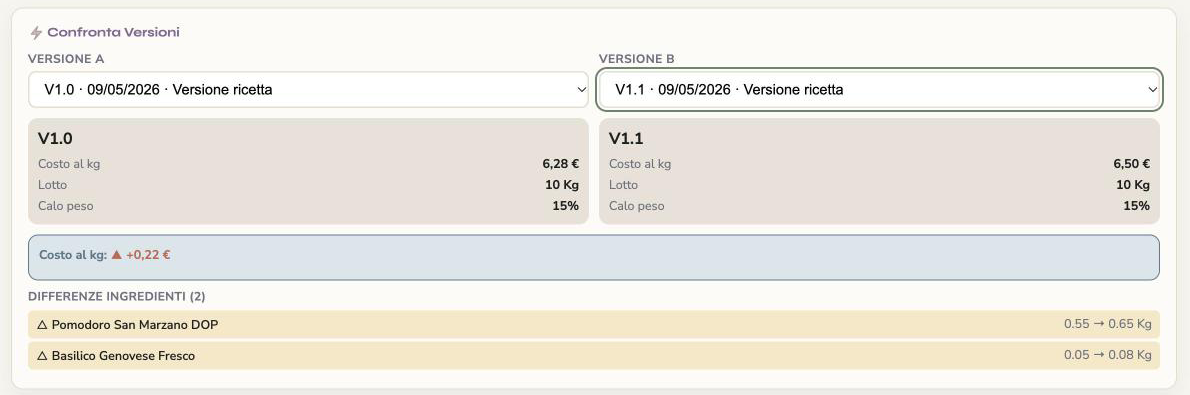
From the Pro plan, when you edit the recipe you can save a new version: each version records cost per kg, batch and weight loss, and you can compare two versions to see what changed in the ingredients and in the cost per kg.
Why it does it
Yield is not a constant of the product but is tied to the process: when the process changes, you need a point of reference to understand how much the change weighed on the cost.
What it solves
You understand whether the cost went up because of a change in weight loss, in ingredients or in prices, instead of just seeing that "something changed".
4. The same figure written in two places
What KoreLab does
If the product has a linked bill of materials, the weight loss in the bill of materials is the only source: it feeds the CPF and also the technical sheet and the labels. There are not two "Weight loss" boxes to keep aligned.
Why it does it
Two boxes with the same name but not connected are the easiest way to make two documents say different things: a bill of materials with 30% and a cost sheet calculated with 15%, for example, gives a wrong number of pieces and a wrong cost per piece.
What it solves
For products with a linked bill of materials, cost, sheet and label start from the same loss, and the numbers do not diverge from one document to another.
Weight loss remains a figure to be measured in your workshop, over several batches: KoreLab does not measure it for you: it has to be set for each bill of materials (if missing, a default value of 15% is used, to be replaced with your own), and once set it is used wherever it is needed. Weight loss matters for the label too: the nutritional values per 100 g refer to the finished product, as we explain in the article on the nutrition declaration per 100 g. To see how the recipe works you can read the page on recipe management.
You can start for free on your first products, without a credit card (the Free plan includes up to 5 bills of materials): create a free account. Versions and version comparison are available from the Pro plan.
In short
Weight loss is the normal loss of weight during cooking or processing; yield is its complement. Ignoring them, by calculating the cost on the raw weight instead of the weight of the finished product, leads to a real cost higher than the calculated one, by an amount that depends on the loss (with a 13% loss, about 15% more) — a silent error that only shows up when you compare the theoretical numbers with real production.